The Count’s antique dueling pistols
A Gentleman in MoscowThe Count’s antique dueling pistols are concealed weapons that become the means by which Count Alexander Ilyich Rostov confronts Bishop Leplevsky in the manager’s office. Their age and apparent impracticality make them look like museum curiosities, but the Count loads both and puts them to use: one is fired into Joseph Stalin’s portrait, while the other is trained on the Bishop. The pistols transform a hidden object into an immediate threat, changing the balance of power in the room and marking a decisive turn in the Count’s escape.
Concealment and Recovery
The pistols are kept in an inlaid box concealed behind a panel in the manager’s office. After descending from the belfry and entering the executive offices unseen, the Count finds the Bishop’s office door locked. He remembers that Nina’s passkey is still in his pocket, lets himself in, and relocks the door behind him. The use of the key brings him into a private room; the hidden panel leads him further, to a concealed object the office’s ordinary furnishings do not disclose.
The panel is located by reference to the portrait of Karl Marx: counting from the portrait, the Count presses the center of the second panel to its right. It opens, revealing the inlaid box in its chamber. The room’s filing cabinets have replaced Mr. Halecki’s chaise, but the concealed space remains accessible. This juxtaposition makes the recovery depend on attention to the office as a layered environment: public furniture and official portraits conceal a compartment containing weapons.
The Count takes the box to the desk and opens it. His brief response registers the discovery, but his next actions make clear that the pistols are not merely objects of admiration. Sitting in the manager’s chair, he removes both, loads them, and waits for the Bishop to return. A few seconds of waiting become preparation: he moderates his breathing, lowers his heart rate, and steadies himself before the key turns in the lock.
The Office Confrontation
The pistols’ effectiveness is first expressed through the Count’s control of the encounter. Bishop Leplevsky closes the office door before noticing that the Count is sitting behind the desk. He initially responds through the language of rank and procedure, insisting that the headwaiter has no business in the office and must leave. The Count raises one pistol and orders him to sit. The weapon interrupts the Bishop’s attempted restoration of the established hierarchy, though the Bishop answers with indignation rather than immediate compliance.
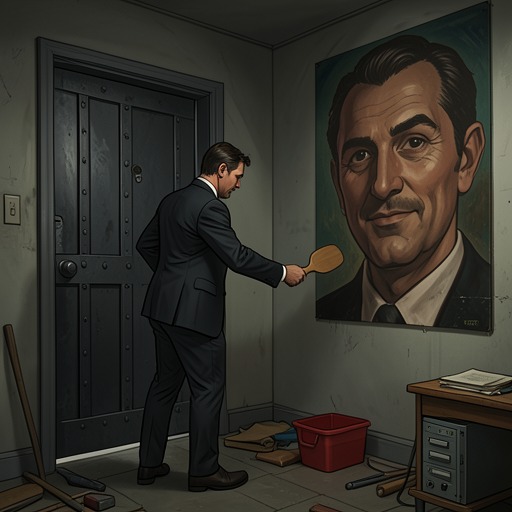
The Bishop has little familiarity with firearms and can barely distinguish a revolver from a semiautomatic. He recognizes, however, that the weapon looks antique—more like a museum piece or curiosity than a modern firearm. That appearance gives him reason to underestimate it, but it does not prevent the Count from using it. When the Bishop threatens to alert the authorities and reaches for one of his telephones, the Count shifts his aim away from him and fires into the portrait of Joseph Stalin.
The shot changes the encounter without striking the Bishop. The sound, the sacrilege of shooting the former Premier’s portrait, or both make the Bishop jump back and drop the receiver. The Count then raises the second pistol and levels it at the Bishop’s chest. On this second order, the Bishop sits. The sequence distinguishes the pistols’ two uses: one discharges into the portrait, disrupting the Bishop’s attempt to summon help; the other remains trained on the Bishop to enforce the Count’s command.
Evidence of Use and Escape
The later account of the incident confirms that the weapons were a pair of antique dueling pistols and that the Count was willing to use them. It identifies the shot into Joseph Stalin’s portrait as a fact established by investigators, not simply as an unexplained disturbance in the office. The pistols therefore connect the hidden compartment to the public consequences of the confrontation: the concealed weapons are recovered, loaded, and used in a way that leaves visible evidence.
That account places the shooting within a broader investigation of the Count’s departure. Investigators report that a Finnish passport and currency were stolen from a Finnish guest two nights earlier, and that a raincoat and hat were stolen from an American journalist the following night. A man in the hat and coat was seen boarding the overnight train to Helsinki. The garments were later found in a washroom at the Russian terminus in Vyborg, along with a Finland travel guide whose maps had been removed. Authorities presume that the Count left the train there to cross the border on foot, though they cannot confirm that he has been caught. The pistols establish how he obtained and used a firearm during the escape; they are one strand in the authorities’ account, alongside the stolen travel documents, clothes, and altered guide.
Narrative Significance
The pistols’ movement from concealed box to loaded weapons gives the scene its material reversal. Before the panel opens, the office appears to be governed by its furnishings, its locked door, and the Bishop’s authority. Once the Count finds the box, the room’s hidden contents alter what its occupants can do. The pistols are no longer inert antiques under concealment; their physical presence commands attention and makes the Count’s order enforceable.
Their antiquity sharpens that reversal. The Bishop’s description of them as museum-like curiosities is not enough to make them harmless: the Count loads both, fires one, and points the other at a man who had expected protocol and official power to protect him. At the same time, the Count does not shoot the Bishop. The portrait receives the shot, while the second pistol holds the Bishop in place. The distinction between discharge and threat is central to the scene’s progression, as is the object’s shift from hidden possession to practical instrument. The pistols do not by themselves explain the Count’s entire escape, but they make its immediate turning point tangible: a pair of old weapons, recovered from a secret compartment, enables him to take control of the office and continue his flight.